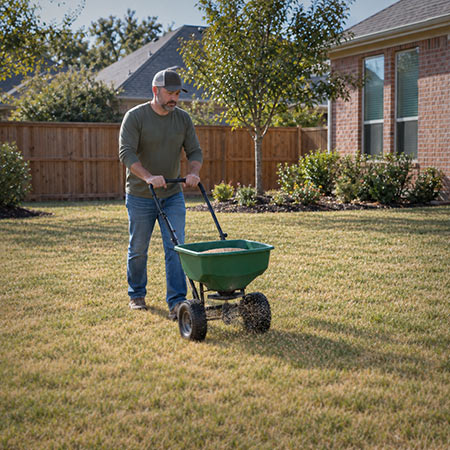
 As temperatures cool in the Katy area, warm-season lawns such as St. Augustine grass, Bermuda grass, and Zoysia grass naturally slow their growth and typically lose some of their green color. Some homeowners respond by overseeding with Rye grass to maintain a green lawn during the winter. Before doing so, it is important to understand that this choice requires additional maintenance and may affect your lawn when warm weather returns.
Overseeding is the process of spreading grass seed over an existing lawn to improve its density, appearance, or seasonal coverage without removing the established turf. It can be done at different times of year depending on the existing grass, local conditions, and the reason for overseeding. For temporary winter grass in the Katy area, Rye grass is commonly used. It is sometimes referred to informally as “winter rye.”
Annual and perennial Rye grass are both available, but they have different characteristics. Annual Rye grass generally has a lighter color and coarser texture, while perennial Rye grass usually produces a finer, darker, and more uniform appearance.
Although perennial Rye grass may provide better winter color, it can remain active longer in the spring and compete with your permanent lawn as it begins growing again. Annual Rye grass typically declines sooner as temperatures rise, which may make the transition back to warm-season grass easier. Despite its name, perennial Rye grass generally does not survive the summer heat in this part of Texas.
The type of permanent turf in your lawn is an important consideration. Bermuda grass, which is found in many Katy-area lawns, is the warm-season turf most commonly overseeded with Rye grass. It should be fully established before overseeding, as dense Rye grass may compete with the Bermuda grass and delay its recovery in the spring. Overseeding a residential St. Augustine grass lawn presents greater challenges. St. Augustine grass grows through above-ground runners and can be stressed by the preparation, close mowing, competition, and extended maintenance associated with overseeding. Texas A&M AgriLife does not generally recommend winter overseeding for home lawns. When a homeowner chooses to proceed, annual Rye grass may create fewer spring-transition problems than perennial Rye grass.
Overseeding also changes a lawn’s winter maintenance needs. Rye grass seed must remain moist while it germinates, which can require frequent, light watering at first. Once established, the lawn may require supplemental watering during dry periods, along with regular mowing and appropriate fertilization. Homeowners should consider these additional requirements before deciding whether several months of winter color are worth the added water use and maintenance.
The frequent watering needed to establish Rye grass can noticeably increase household water use during winter months when outdoor irrigation demand is usually low. HCMUD 71 residents can monitor their daily and hourly water use and sign up for automated leak alerts through EyeOnWater at www.eyeonwater.com/signup.
Timing also matters. Seeding too early can place the young Rye grass in competition with turf that is still actively growing and may increase the potential for disease. Seeding too late may leave young seedlings vulnerable to cold weather. Because seasonal temperatures vary from year to year, homeowners should base planting decisions on local conditions rather than relying on a fixed calendar date.
Spring transition is another important consideration. As temperatures rise, the permanent lawn must resume active growth while the Rye grass begins to decline. If the Rye grass remains dense too far into spring, it can shade and compete with the underlying turf. The Rye grass may then die rapidly as temperatures increase, leaving a temporary thin or uneven appearance while the warm-season lawn recovers.
For many Katy-area homes, allowing the permanent lawn to enter its natural winter dormancy is the simplest option. A dormant lawn is not necessarily dead or unhealthy. Reducing irrigation and mowing as growth slows allows the turf to follow its normal seasonal cycle without competition from temporary Rye grass.
Homeowners considering overseeding should first identify their existing turf type and review any applicable homeowner’s associations HOA landscaping guidelines. They should also consider recent herbicide applications, since some pre-emergent products intended to prevent winter weeds may also prevent Rye grass seed from germinating. Product labels should always be read and followed carefully.
Overseeding with Rye grass can provide temporary winter color, but it is not necessary for maintaining a healthy lawn. For most St. Augustine grass lawns in the Katy area, allowing natural dormancy is generally the lower-maintenance and lower-cost choice. Homeowners who decide to overseed should select the Rye grass carefully and plan for the additional watering, mowing, and spring transition management the process requires.
Additional information is available from Texas A&M AggieTurf.