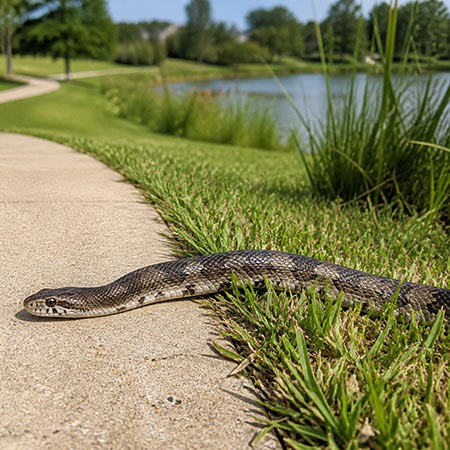
 Residents in HCMUD 71 occasionally report seeing snakes in neighborhood parks, along trails, near detention ponds, and around lake edges. These sightings are especially common in the warmer months when snakes are most active. While snake sightings can be startling, snakes are not unusual in Southeast Texas, and in most cases are not dangerous.
Southeast Texas is home to a wide variety of native snakes, many of which play a valuable role in the local ecosystem by helping control rodent and insect populations.
Among the most common non-venomous species in the Katy area are the Texas Rat Snake, Rough Green Snake, and Diamondback Water Snake. These snakes are generally harmless and avoid human contact when left undisturbed.
Which Snakes Are of Concern?
However, there are a few venomous snakes native to this region, and the venomous species of greatest concern around lakes, detention ponds, and drainage areas is the Western Cottonmouth, also known as the Water Moccasin.
The Cottonmouth is a semi-aquatic member of the pit viper family and is native to Texas and the Southern United States. It can often be found near lakes, creeks, drainage ditches, and other slow-moving water sources. Adult Cottonmouths range in size from 20 to 48 inches and are known for their dark, nearly black coloring, thick triangular head, and short, stubby tail. They are most easily identified when threatened, as they may coil their bodies, lift their heads, and open their mouths wide to display the bright white interior that gives them their “cottonmouth” name.
Snakes are most active between April and October, with peak activity typically occurring in the hotter summer months. They tend to avoid extreme temperatures, becoming less active below 50°F and above 90°F. You are most likely to encounter a snake near shaded brush, tall grass, or warm concrete paths and sidewalks in the early morning or late evening.
How Can You Improve Safety Around Snakes?
For your safety, all snakes, venomous or not, should be left alone. Most snake bites in the United States occur when someone tries to kill, handle, or move a snake.
Although serious snakebites are uncommon, any suspected venomous snakebite should be treated as an emergency. If someone is bitten by a venomous snake, seek medical attention immediately. Call 911 or the Texas Poison Center Network at (800) 222-1222 for guidance, including information about nearby medical facilities that may have the appropriate antivenom.
As a precaution, residents are encouraged to:
- Avoid walking through tall grass or brush where snakes may hide.
- Watch where you step, especially near rocks, culverts, or shoreline vegetation.
- Keep pets leashed and away from water’s edge or wooded areas.
- Teach children not to touch or approach any wild animal, including snakes.
If a snake is behaving defensively, trapped in a public space, or suspected to be venomous and posing a threat, residents should keep a safe distance. If the snake is located in District-maintained parks or common areas, please also notify the District’s operator, Regional Water Corporation, at (281) 897-9100. For snakes on private property, homeowners may contact a licensed wildlife removal professional.
Snakes are an important part of the natural balance in our wetlands and green spaces. With increased awareness and caution, residents can safely enjoy the outdoors while respecting our native wildlife.